









Superelements in FEA

Written by: Tom McHale
Published: Feb 16, 2023
| View All Blogs
What is a Superelement?
In the FEA process we’re discretising the geometry of our structure to simple forms for which stiffness can be evaluated easily, combined into a matrix, and the displacement for an applied load calculated. A Superelement is a method of representing an entire structure with a single entity within our FEA model.
Why would we use a Superelement?
Back in the 1960’s when the first computerised implementation of the Finite Element Method was used for the NASA Apollo missions the available compute power was tiny and so model sizes were very limited. Superelements were developed as a method for substructuring an assembly to maximise the benefit of the limited resources available. For example, an antenna structure deployed in orbit could be reduced to a Superelement representing the mass, stiffness and dynamic behaviour of the antenna as a few simple matrices at the interface nodes to the main structure.
How do they work?
Let’s look at this with an example. Let’s say we produce test equipment for fatiguing wind turbine blades. We want to perform detailed stress and stiffness analysis on our system to ensure it does not fail itself in fatigue and that there are no unfortunate harmonic effects of the blade being tested on it. The blade model provided by our client is meshed with ~91k nodes which will result in a model with around half a million DOFs and adding this into the system FEA model will result in a very large model.
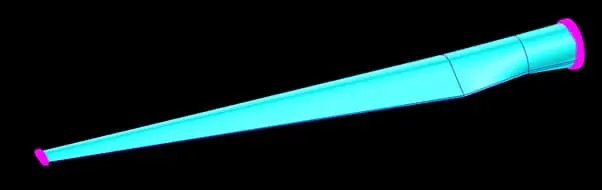
The blade is loaded in bending at the tip and fixed to the test rig at the base via the centre of the collar. The loading speed for these tests is up to 5Hz, meaning we would need to include the normal modes up to 10Hz in our solution to ensure accuracy.
To reduce this model we identify the interface points between the model and the rig which in this case are a node at each end which is connected to the mesh via a multipoint constrain. The first phase of the reduction is the static, or constraint mode, reduction. What happens here is as sequence of static solutions. All DOF’s at end A are fixed and all but the X direction at end B. A unit displacement is applied in the X direction at B.
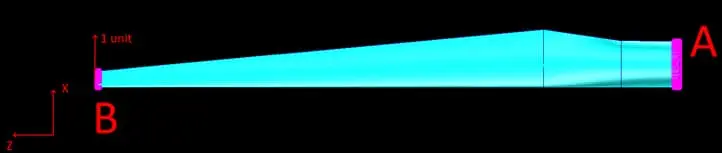
This is then repeated so that a unit displacement is applied to each DOF at each end while the others are fixed. The displacement and force required are retained for all 12 modes.
Since this is to be used in a dynamics analysis we also need a dynamic reduction. This is performed via a normal modes analysis with the interface nodes restrained. In this case it yields 3 modes up to 10Hz.
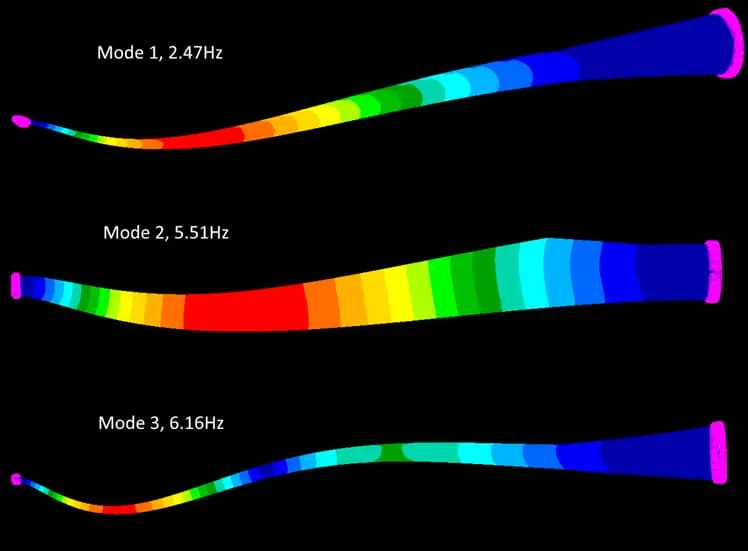
All of this information is stored in matrix form as a file along with the information needed to connect this superelement back to the test rig model.
When we use this as part of our rig dynamics model, we simple point at the superelement file and relate the interface nodes to nodes in our rig model. At any step of the analysis the deformation of the blade, and hence it’s effect on the rig, can be expressed as a linear superposition of the 12 constraint modes and the three normal modes, effectively reducing the burden on the solver from ~500k nodal DOF to 15 modal DOF with all the benefits on resources used and runtimes that gives.
Why would we still use this technique?
Why don’t we just buy a bigger computer and more RAM/Disk and avoid this whole process? There’s a number of good reasons this technology is still used.
Preserve intellectual property.
Let’s say you’re a company that has developed a novel technology that is used widely in the automotive industry. The car companies want to include your FEA models in their global NVH models but in doing so you risk exposing your IP. By supplying them with a Superelement they can incorporate a very good representation of the static and dynamic behaviour of your product in a format that cannot be reverse engineered.
Speed up your solution time.
Several FEA companies make use of this technology in an automated way to reduce runtimes of large FEA models. Automated Component Mode Synthesis is used in Nastran for example to take a very large model, break it into hundreds or thousands of tiny superelements, solve them in parallel and recombine for the full solution. With some of our customers this technique has reduced the runtime dramatically without the need to purchase new hardware, in one instance by nearly 90% with no loss of accuracy.
To speed design iterations.
Turning the subsystem example on it’s head, perhaps you are designing the subsystem and need to analyse it in the context of the whole system. Running the full system model each time is lengthy and may take an overnight run, limiting your productivity. If you could reduce the millions of nodal DOF’s for the system model to 10’s or 100’s of modal DOFs you could be running several iterations per day, improving productivity and reducing time to market for your product. MSC Software’s Apex and Nastran are moving towards a method of representing an assembly of FEA parts wherein a superelement reduction is automatically generated per part meaning that when a full assembly run is made only the changed parts need to go through a full solve which will have a big impact on productivity for large and complex models.
To improve motion dynamics models.
If you develop moving systems you probably run motion dynamics simulation to validate the range of operation and understand the forces in the system. These models generally represent everything as a rigid body for simplicity, but integrating a superelement reduction in place of a rigid component allows you to represent a body as flexible to increase the fidelity of your model with only a few incremental degrees of freedom added to the mode. MSC Adams allows you to do this very simply and with the added benefit that you can recover stress history for the flexible parts for durability considerations.
Conclusion
Superelements are still widely used in a number of industries, mainly Aero and particularly the Space industry. Sometimes our very first interaction with a new client runs along the lines of “I’ve been told to use/supply something called a superelement, help!”. We have a lot of experience in this area and can help you get started and support you so make best use of them and supply a quality file to your clients with no baked-in faults that will cause issues for them when they use your file in their model.
If you have a requirement to deliver or use this technology, or if one of the other reasons to use it sounds like it could have a positive effect on your process, please get in touch. Leasing MSC Nastran through the MSC One token system is surprisingly affordable and comes with full technical support from ourselves and MSC directly, accessing many decades of experience.
Categorised as: Simulation
Get a SOLIDWORKS Quote
Interested in SOLIDWORKS? Contact us for questions, trials, or demos by clicking the button below or call 01926 333777. Our experts will help you find the perfect solution.

Related Posts
How to Find Reaction Forces in SOLIDWORKS Simulation
SOLIDWORKS helps us to find resultant forces through simulation studies. These virtual tests reduce the need for physical prototypes and give us an accurate answer.

SOLIDWORKS Tips: Are you Making this Common Mistake in Fatigue Analysis?
Simulation is a vital and complex engineering need. Fortunately, SOLIDWORKS makes it easy to test, correct mistakes and obtain accurate results.
Redesigning Santa’s Sleigh in SOLIDWORKS
Every year Father Christmas has to fly in his sleigh to deliver presents to boys and girls all over the world in just one night. To put this into perspective, it takes a little under 24 hours to fly from London (UK) to Sydney (Australia) in a streamlined Boeing 747, whereas Father Christmas’ mode of transport is believed to be a rather non-aerodynamic sleigh.
Radiation in Flow Simulation – Part 1 : Reflection
Technical Manager Andy Fulcher explores ‘Radiation in Flow Simulation, Part 1 : Reflection’
Radiation in Flow Simulation – Part 2 : Refraction
Technical Manager Andy Fulcher explores ‘Radiation in Flow Simulation, Part 2 : Refraction’
The Coanda Effect in Flow Simulation
Can you take advantage of the Coanda Effect & can SOLIDWORKS Flow simulate it? Applications Engineer Romel Cumare investigates in his latest blog post.
So how accurate is SOLIDWORKS Simulation?
How accurate is SOLIDWORKS Simulation? Elite Applications Engineer Chris Boyles investigates.
Set Your Fluids Free with SOLIDWORKS Flow Simulation
A look at the new Free Surface feature coming in SOLIDWORKS Flow Simulation 2018.
Finding a Good Mesh Fast in SOLIDWORKS Flow Simulation
‘How do I know when to stop my calculation?’ and ‘How do I know my mesh is good enough?’ are questions often asked when running SOLIDWORKS Flow Simulation studies.
The answer is to ensure the solution reached is both fully converged AND mesh independent. In practice this can take a bit of trial and error as well as some experience in the process. However, SOLIDWORKS Flow can help us do both of these at once! Here’s how…

Free Surface Evaluation & Validation – SOLIDWORKS Flow Simulation
In 2018 SOLIDWORKS introduced a new capability to their Flow software. This is called ‘Free Surface’ and opens up many more applications for users who need to simulate fluid behaviour where a gas and a liquid (or two immiscible liquids) share the same region of space without an intervening solid