









Part Numbering in SOLIDWORKS PDM Professional

Written by: Wayne Marshall
Published: Nov 20, 2020
| View All Blogs
When implementing a new SOLIDWORKS PDM Professional Vault Customers will have the option to review their part numbering and classification requirements as they move to a system that allows them to, in most cases, automate the way the identify ‘parts’ within the Vault. Part Numbering is something that a lot of customers approach differently and this is often based on ‘how it’s always been done’ without necessarily considering what is the purpose of a Part Number within their organisations and wider within their supply chains. If we consider the humble part number. What is it’s purpose?
If we consider the humble part number. What is it’s purpose?
In essence, a part number is simply a unique identifier for an item approved for a specific application. It’s formatting should be consistent, and remain unambiguous throughout that items lifecycle. This is essential for correct product assembly, testing and maintenance.
A good part number therefore simply allows us to clearly distinguishing one part from other.
There are other good practices we should consider though.
- Numbers should have a consistent number of characters, noting that based on research a string of more than 7 characters increases the risk of data entry errors and are a lot less memorable
- Numbers should have a consistent format that is easily identifiable and not prone to being truncated if reproduced in another system where (for example) leading zeros are not permitted in a field.
To address the above customers will typical employ perhaps one of three approaches.
- Simple Sequential Document and Part Numbers. These can be assigned by PDM out of the box and can also be configured to include a fixed component (a pre or post-fix) that when added to a PDM file Template or file specific DataCard can create a semi-significant scheme that, for example, distinguishes between Parts and Assemblies through a basic mnemonic (P for Parts, A for Assemblies etc). Semi-Significant or Significant / Intelligent Part Numbers, which require human interpretation and assignment, can take a number of forms
- Semi-significant numbers can be assigned where simple classification requirements vary a prefix based on a high level classification. This could be to differentiate between a designed component and a bought in part. This could also be to tag a component as being Project or Product Specific, by (for example) including an inherited Project or Product number within the prefix that the sequential counter is assigned to. It could also be used to differentiate between types of Assemblies, where (for example) a top level arrangement is numbered differently to the subassemblies that make it up.
- Significant / Intelligent numbers are often built up of a number of discreet components that can describe the part or assembly using codes to illustrate things such as a component category and sub-category / type, specific options, colour, finish and even Revision. These tend to be hangovers from a Pre-CAD era and often have accompanying ‘guides’ that a new employee must learn. This learning curve is not straight forward however, as there are often outliers – new variants and exceptions that do not fit within the original design of the Intelligent part numbering system.
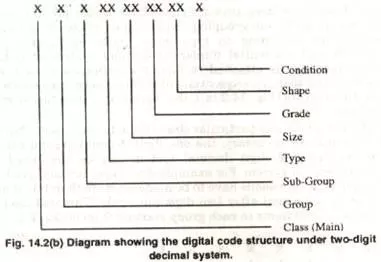
The Brisch system is an example of a classification model widely used from the 1950’s onwards. It consists of seven digits and is applied in three phases. The items are grouped into suitable preliminary categories, such as assemblies, sub assemblies, components, off the shelf items. After these preliminary categories, items are grouped with in the respective groups in order to bring similar items together.
These sorts of approaches, although common are rarely flexible enough to remain in sync with technology, engineering methods, materials and processes over a prolonged period of time.
The most critical of these issues is that over time the significant numbering systems tend to break down… As time passes variations arise which were not foreseen. One digit was set aside where two are now needed. Significant numbers thus tend to lose their significance. They no longer do the classification coding function intended by their inventors.
– Watts: Engineering Documentation Control Handbook page 49
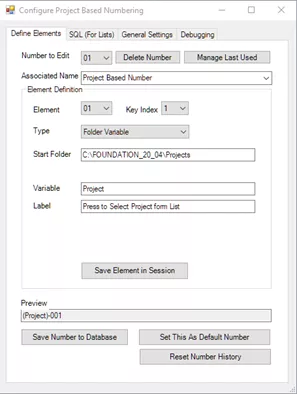
Although Solid Solutions would advocate the use of a Simple or Semi-Significant number within PDM; with metadata being used to describe the component in a much more ‘user friendly’ and sustainable way. We appreciate that Customers will in some cases not be able to shake off a legacy numbering scheme or will require a small degree of intelligence that is not possible ‘Out of the box’ in SOLIDWORKS PDM. For this reason we have developed the ProjectNumbering Serial Number add-in for SOLIDWORKS PDM Professional.
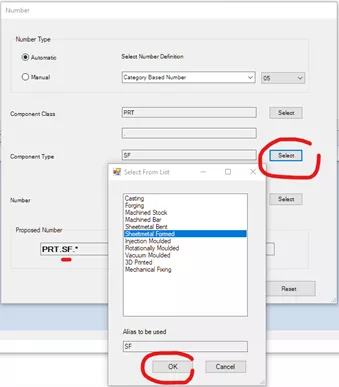
Capabilities
The add-in is linked to a SOLIDWORKS PDM Professional ‘Serial Number’ which enables it to be triggered via Save (inside SOLIDWORKS), via DataCard (default value), Template Card, Copy and Move Tree.
- Single ‘Serial Number’ component can generate many configured number types.
- Default ‘Number’ can be specified
- Numbers can contain up 10 elements with the ‘Key Index’ used to allocate a specific numeric counter to the configured number.
- Multiple Elements can be combined to create the ‘Key Index’. Elements consist of…
- Fixed Text / Separators
- Folder Variable values inherited from the Folder Card associated with the location of the new ‘part’ (e.g. Project Number)
- PDM Lists (using the ‘Alias’ type lists in PDM Professional we can select descriptive text from a list that adds a predefined Alpha / Numeric string to the ‘Key Index’
- Counter (specify string length, initial value and increments)
Project Numbering is already included as standard for Customers taking our FOUNDATION Implementation Package for SOLIDWORKS PDM Professional but can also be purchased as an add-on for any existing SOLIDWORKS PDM Professional Vaults.
For a more detailed view of the add-in in action take a look at this short video demonstration.
Categorised as: Data Management | SOLIDWORKS PDM
Get a SOLIDWORKS Quote
Interested in SOLIDWORKS? Contact us for questions, trials, or demos by clicking the button below or call 01926 333777. Our experts will help you find the perfect solution.

Related Posts

How to Create a Pack and Go in SOLIDWORKS
Pack and Go in SOLIDWORKS should be used when sending SOLIDWORKS files to another person. Use this simple guide to help you safely send entire SOLIDWORKS projects.
What is 3DSWYM? A 3DEXPERIENCE Platform Tutorial
3DSwym is the application at the heart of the 3DEXPERIENCE, allowing users to connect and collaborate across the platform.
Microsoft SQL Server licensing for SOLIDWORKS PDM
October 2020 marks two important milestones for the SOLIDWORKS PDM family and SQL Server.

The 6 Golden Rules of Managing Data in SOLIDWORKS
When modelling in SOLIDWORKS, before you know it, you will have created lots of parts, assembly and drawing files, so it’s important to think about how you will manage these files and keep everything organised. Here we discuss the ‘6 Golden Rules’ of managing your SOLIDWORKS files using Windows Explorer and recommended methods for file naming, structuring your projects and managing revisions.
This kicks off a month looking at the management of CAD data, register for one of our upcoming live webinars at the bottom of this article.

PDM Professional – Assigning Users with Conditional Notifications
Often customers will create smaller project teams for specific jobs and in the past we have been asked if it is possible, within a multi stage workflow, to pre-assign at the creation stage users who will be notified as checker / approver within those transitions. This blog will demonstrate how, using conditional Notifications in PDM Professional, this can be configured. We will also create some logic to allow for certain parts of the workflow to be bypassed by validating the selected ‘names’ against transition conditions. In this example the ‘approvers’ will be assigned on the files DataCard, but it would be just as feasible to have these names inherited from a project folder card if defining the rules at a higher level was possible within your Teams.
Managing Disk Space with SOLIDWORKS PDM Part #1: Distributing the Archive
This blog series was prompted by a recent support ticket, logged when a customer found their PDM Professional installation suddenly became unusable. The warning message, led to my reviewing the Archive Server Log file and this quickly identified the problem being a result of the PDM Server running out of disk space.
Managing Disk Space with SOLIDWORKS PDM Part #2: Deleted vs Destroyed and the Vault Cleaner Service
In this blog series we are examining the factors influencing disk usage within PDM and what you can do to manage them. In the first part we discussed how you can re-organise your archive across multiple drives to get you back up and running quickly should you find you are short on space. This blog and the next part will discuss behaviours in PDM that can result in redundant disk usage and how you can free that up with the vault cleaner service.
Managing Disk Space with SOLIDWORKS PDM Part #4: Cold Storage
In this blog series we are examining the factors influencing disk usage within PDM and what you can do to manage them. In the first part we discussed how you can re-organise your Archive across multiple drives to get you back up and running quickly should you find you are short on space. In the second part we looked at the differences between a deleted and a destroyed file and the impact the PDM recycle bin has on Disk usage. Part three discussed temporary session files created by the PDM Web Server and this Part will look at an option within PDM called Cold Storage.
Managing Disk Space with SOLIDWORKS PDM Part #5: Archive Compression
In this blog series we are examining the factors influencing disk usage within PDM and what you can do to manage them. In the first part we discussed how you can re-organise your archive across multiple drives to get you back up and running quickly should you find you are short on space. In the second part we looked at the differences between a deleted and a destroyed file and the impact the PDM recycle bin has on Disk usage. Part three discussed temporary session files created by the PDM Web Server. In part four we discussed cold storage and in this last part we will look at archive compression.

What’s the difference between SOLIDWORKS PDM Standard, Professional and Manage?
SOLIDWORKS offer two core PDM packages: PDM Standard and PDM Professional. The recent release of SOLIDWORKS Manage builds upon the functionality of SOLIDWORKS PDM Professional, but what’s the real difference?