









PLM vs PDM: What’s the Difference?

Written by: Wayne Marshall
Published: Aug 22, 2022
| View All Blogs
Coming up with a product idea can be easy, but moving that idea from an early concept, all the way through to it being in the customer’s hands is a lot harder. Managing that process efficiently and coherently makes it even more complex — balancing working practices, product data and stakeholder satisfaction in tandem.
How you and your internal and external teams collaborate during product development will define whether your projects succeed or fail. Technology solutions such as PDM and PLM are there to help ensure each project succeeds by helping you align your product design, production and business processes.
Finding the right solution for your business can be a challenging, and often confusing process. Before trying to decide on the right one, it’s important to understand the differences between these technologies and their use cases.
What is Product Data Management (PDM)?
PDM systems help engineering teams organise their product design files by providing a single source of truth, robust version control, change control and a collaborative platform. Engineers don’t have to worry about working from wrong file versions or missing important updates and can focus on developing cutting-edge designs instead.
Typically, PDM systems manage product design data. That includes specifications and material data used in production and it usually takes the form of physical design files (CAD) or design simulation (CAE). PDM systems then maintain the hierarchical structure of these files (parent-child relationships).
Ranging from complete redesigns to tiny tweaks, updating design files in a single location means that design collaborators save time and easily note revisions that might have been missed otherwise. Keeping these design files updated whilst preserving previous iterations prevents costly errors; everyone knows when, why and what changes have been made.
The main takeaway is that PDM focuses on CAD data and solves challenges experienced in the early product development lifecycle. Interactions with people outside of engineering can’t solely be done in a PDM tool – if a business needs to manage these sorts of interactions, then this is where a Product Lifecycle Management (PLM) system comes to the fore.
What is Product Lifecycle Management (PLM)?
PLM systems capture and manage the whole product lifecycle by sharing a broader set of product data than a PDM system would. This includes product data such as requirements, bills of materials, project plans, problem reporting, manufacturing data, design approvals, packaging, marketing information … the list goes on.
By storing every piece of product-specific data, PLM systems help businesses break down communication silos across all of their internal and external teams and processes by implementing a single, unified repository. PLM systems also connect the data, business processes, and people assigned to those processes. This interconnectivity of data is what’s referred to as ‘the digital thread’. It enables a connected flow of data as well as an integrated view of the product’s data from different functional perspectives. An example would be the procurement team only wanting to see procurement data for the product; if engineering changed part of the design, the procurement team would be informed and be able to gauge the impact of the change on their work and carry out the change in the system too.
Essentially, PLM systems play a central role when it comes to tracking who’s assigned to specific pieces of the product development process and their impact on other stakeholders, ensuring everything’s progressing according to schedule.
PLM vs PDM: Which one to go for?
Having considered all of that, the question is: Which tool does your business need—a PDM system to manage product design data for your engineers or a PLM system to manage comprehensive product data sets for your entire business?
Regardless of which route you choose; our Business Transformation team are on hand to walk you through the discovery process. With the team having experience and access to both PDM and PLM solutions, you can be assured that the team will conduct the discovery with no bias towards a particular solution and instead will do their best to identify the correct solution for your business based on your current position and your future aspirations.
Categorised as: Data Management
Get a SOLIDWORKS Quote
Interested in SOLIDWORKS? Contact us for questions, trials, or demos by clicking the button below or call 01926 333777. Our experts will help you find the perfect solution.

Related Posts
How to Create a Pack and Go in SOLIDWORKS
Pack and Go in SOLIDWORKS should be used when sending SOLIDWORKS files to another person. Use this simple guide to help you safely send entire SOLIDWORKS projects.
What is 3DSWYM? A 3DEXPERIENCE Platform Tutorial
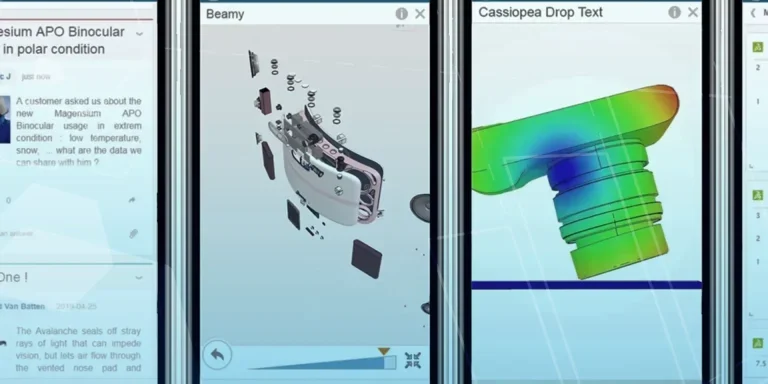
3DSwym is the application at the heart of the 3DEXPERIENCE, allowing users to connect and collaborate across the platform.
Microsoft SQL Server licensing for SOLIDWORKS PDM
October 2020 marks two important milestones for the SOLIDWORKS PDM family and SQL Server.

Part Numbering in SOLIDWORKS PDM Professional
When implementing a new PDM Professional Vault Customers will have the option to review their part numbering and classification requirements as they move to a system that allows them to, in most cases, automate the way the identify ‘parts’ within the Vault. Part Numbering is something that a lot of customers approach differently and this is often based on ‘how it’s always been done’ without necessarily considering what is the purpose of a Part Number within their organisations and wider within their supply chains. If we consider the humble part number. What is it’s purpose?

The 6 Golden Rules of Managing Data in SOLIDWORKS
When modelling in SOLIDWORKS, before you know it, you will have created lots of parts, assembly and drawing files, so it’s important to think about how you will manage these files and keep everything organised. Here we discuss the ‘6 Golden Rules’ of managing your SOLIDWORKS files using Windows Explorer and recommended methods for file naming, structuring your projects and managing revisions.
This kicks off a month looking at the management of CAD data, register for one of our upcoming live webinars at the bottom of this article.

PDM Professional – Assigning Users with Conditional Notifications
Often customers will create smaller project teams for specific jobs and in the past we have been asked if it is possible, within a multi stage workflow, to pre-assign at the creation stage users who will be notified as checker / approver within those transitions. This blog will demonstrate how, using conditional Notifications in PDM Professional, this can be configured. We will also create some logic to allow for certain parts of the workflow to be bypassed by validating the selected ‘names’ against transition conditions. In this example the ‘approvers’ will be assigned on the files DataCard, but it would be just as feasible to have these names inherited from a project folder card if defining the rules at a higher level was possible within your Teams.
Managing Disk Space with SOLIDWORKS PDM Part #1: Distributing the Archive
This blog series was prompted by a recent support ticket, logged when a customer found their PDM Professional installation suddenly became unusable. The warning message, led to my reviewing the Archive Server Log file and this quickly identified the problem being a result of the PDM Server running out of disk space.
Managing Disk Space with SOLIDWORKS PDM Part #2: Deleted vs Destroyed and the Vault Cleaner Service
In this blog series we are examining the factors influencing disk usage within PDM and what you can do to manage them. In the first part we discussed how you can re-organise your archive across multiple drives to get you back up and running quickly should you find you are short on space. This blog and the next part will discuss behaviours in PDM that can result in redundant disk usage and how you can free that up with the vault cleaner service.
Managing Disk Space with SOLIDWORKS PDM Part #4: Cold Storage
In this blog series we are examining the factors influencing disk usage within PDM and what you can do to manage them. In the first part we discussed how you can re-organise your Archive across multiple drives to get you back up and running quickly should you find you are short on space. In the second part we looked at the differences between a deleted and a destroyed file and the impact the PDM recycle bin has on Disk usage. Part three discussed temporary session files created by the PDM Web Server and this Part will look at an option within PDM called Cold Storage.
Managing Disk Space with SOLIDWORKS PDM Part #5: Archive Compression
In this blog series we are examining the factors influencing disk usage within PDM and what you can do to manage them. In the first part we discussed how you can re-organise your archive across multiple drives to get you back up and running quickly should you find you are short on space. In the second part we looked at the differences between a deleted and a destroyed file and the impact the PDM recycle bin has on Disk usage. Part three discussed temporary session files created by the PDM Web Server. In part four we discussed cold storage and in this last part we will look at archive compression.