









Product Lifecycle Management (PLM) Top 10 Benefits

Written by: Wayne Marshall
Published: Jul 22, 2022
| View All Blogs
Contrary to popular belief, a Product Lifecycle Management (PLM) Platform goes beyond the design and engineering departments, and encompasses the organisation as a whole. Because of this, benefits can be unlocked across the entire organisation, but to truly benefit from a PLM Platform, an organisation needs to appreciate that it isn’t just software for the engineering and operations teams, it’s a business-wide transformation.
1) ‘Single Source of Truth’ (Centralisation)
With Product Lifecycle Management data being utilised by nearly every department within a company it is easy for data to become out of date in minutes. If the data is not held and maintained within a central repository that everyone works from, departments can soon be working on out-of-date information. By having a centralised PLM Platform everybody is able to access the same data and see updates and changes as they happen in real-time, reducing the risk of mistakes being made due to incorrect information.
2) Reduced Development Cycle
By creating that ‘single source of truth’ for the product data, it’s easier for design teams to collaborate through the development stage. Along with adopting other PLM and Manufacturing technologies, a product can be virtually designed, reviewed, analysed and produced. All this combined means that the time taken to develop a product can be significantly reduced.
3) Decreased Compliance Risks
Ensuring that a product meets all the latest compliance standards, requirements and regulations is a role that can quickly become uncontrollable. By managing all the documentation and processes related to ensure your products are meeting the relevant standards, requirements and regulations in a single PLM Platform, organisations can quickly and easily audit what has already been achieved and what needs to be completed.
4) Reduced Costs
With the adoption of a PLM Platform companies create a central repository of all their design and engineering data. This means when it comes to developing a new product, part of the work may already be done, and any lessons learnt from previous projects can be carried across to ensure that no costly mistakes are made.
5) Drive Innovation
With every member of the organisation working on a single PLM Platform, users can share and evaluate feedback from various departments that interact with the products, from customer support through to the sales team. This means the engineering and design teams can take this feedback and enhance and improve product development and innovation.
6) Enhanced Product Quality
By allowing the entire organisation access to the PLM Platform, the design and development teams are able to get useful information about existing products from the Sales, Marketing and Customer Services teams. This information is vital to the continued development and improvement of products to ensure ever-increasing product quality. Having a central repository allows the teams to access the data in real-time and relate it to planned or proposed product innovations and development.
7) Increased Productivity
Product Lifecycle Management (PLM) enables companies to improve operational efficiency through removing non-value-added tasks and streamlining and automating workflows and internal processes where possible. Along with adopting design templates and automation, users can generate product information quickly without having to go from one system to another and kick off workflow manual. With all the product, project and manufacturing information held in a central location teams are able to search, access and reuse that data quicker than ever before, along with the focus to shift and improve productivity across the business.
8) Business Scalability
With an ever-changing landscape, businesses are required to be agile and react to new regulations, changes in customer demands along with developments in their industry. They also have the additional challenge of ensuring they stay competitive. A PLM Platform allows the business to adapt and scale as required.
They can increase the level of product customisation required, re-use existing parts to develop new products or product lines quickly, they are able to collaborate with partners and suppliers in a single platform as well as being able to provide a holistic view of every project and product within the business. All of these abilities combined mean companies can scale and adapt to changes to ensure they can grow and increase their revenue.
9) Improved Customer Loyalty
Customer feedback is crucial to any business, and with a PLM Platform that’s been adopted by the entire organisation, your customer service team are able to provide crucial customer feedback and experiences directly into the PLM Platform allowing this data to be reviewed by engineering, operations and production teams allowing them to react to that feedback and adjust either the product or the production process accordingly, to ensure that customer satisfaction is increased, meaning you have improved customer loyalty.
10) Supplier Collaboration & Integration
OEMs are becoming ever reliant on their supply chain, and it’s not just the OEMs with Tier 1 and Tier 2 suppliers having numerous suppliers under them it is important for information to be fed back. As we know from Jaguar Land Rover’s (JLR) Case Study , JLR has brought in their suppliers into their PLM Platform to help synchronise the teams across multiple organisations to ensure that can collaborate easier on new projects.
By having the suppliers working within their PLM Platform, JLR is able to ensure that they always have the most up-to-date product data without waiting for a supply to send them that data, and in turn, can provide design reviews and feedback instantly to help streamline the product reduction process and accelerate the time to market.
Categorised as: Data Management | What's New
Interested in Product Lifecycle Management?
To explore what benefits your business could gain from integrating a Product Lifecycle Management (PLM) solution.

Related Posts
How to Create a Pack and Go in SOLIDWORKS
Pack and Go in SOLIDWORKS should be used when sending SOLIDWORKS files to another person. Use this simple guide to help you safely send entire SOLIDWORKS projects.
What is 3DSWYM? A 3DEXPERIENCE Platform Tutorial
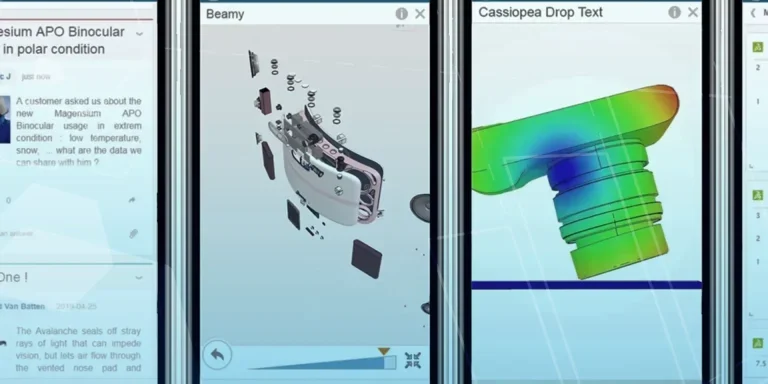
3DSwym is the application at the heart of the 3DEXPERIENCE, allowing users to connect and collaborate across the platform.
Microsoft SQL Server licensing for SOLIDWORKS PDM
October 2020 marks two important milestones for the SOLIDWORKS PDM family and SQL Server.
Part Numbering in SOLIDWORKS PDM Professional
When implementing a new PDM Professional Vault Customers will have the option to review their part numbering and classification requirements as they move to a system that allows them to, in most cases, automate the way the identify ‘parts’ within the Vault. Part Numbering is something that a lot of customers approach differently and this is often based on ‘how it’s always been done’ without necessarily considering what is the purpose of a Part Number within their organisations and wider within their supply chains. If we consider the humble part number. What is it’s purpose?

The 6 Golden Rules of Managing Data in SOLIDWORKS
When modelling in SOLIDWORKS, before you know it, you will have created lots of parts, assembly and drawing files, so it’s important to think about how you will manage these files and keep everything organised. Here we discuss the ‘6 Golden Rules’ of managing your SOLIDWORKS files using Windows Explorer and recommended methods for file naming, structuring your projects and managing revisions.
This kicks off a month looking at the management of CAD data, register for one of our upcoming live webinars at the bottom of this article.

PDM Professional – Assigning Users with Conditional Notifications
Often customers will create smaller project teams for specific jobs and in the past we have been asked if it is possible, within a multi stage workflow, to pre-assign at the creation stage users who will be notified as checker / approver within those transitions. This blog will demonstrate how, using conditional Notifications in PDM Professional, this can be configured. We will also create some logic to allow for certain parts of the workflow to be bypassed by validating the selected ‘names’ against transition conditions. In this example the ‘approvers’ will be assigned on the files DataCard, but it would be just as feasible to have these names inherited from a project folder card if defining the rules at a higher level was possible within your Teams.
Managing Disk Space with SOLIDWORKS PDM Part #1: Distributing the Archive
This blog series was prompted by a recent support ticket, logged when a customer found their PDM Professional installation suddenly became unusable. The warning message, led to my reviewing the Archive Server Log file and this quickly identified the problem being a result of the PDM Server running out of disk space.
Managing Disk Space with SOLIDWORKS PDM Part #2: Deleted vs Destroyed and the Vault Cleaner Service
In this blog series we are examining the factors influencing disk usage within PDM and what you can do to manage them. In the first part we discussed how you can re-organise your archive across multiple drives to get you back up and running quickly should you find you are short on space. This blog and the next part will discuss behaviours in PDM that can result in redundant disk usage and how you can free that up with the vault cleaner service.
Managing Disk Space with SOLIDWORKS PDM Part #3: Web2.0 Temporary Session Files
In this blog series we are examining the factors influencing disk usage within PDM and what you can do to manage them. In the first part we discussed how you can re-organise your archive across multiple drives to get you back up and running quickly should you find you are short on space. In the second part we looked at the differences between a deleted and a destroyed file and the impact the PDM recycle bin has on Disk usage. In this third part we are looking at storage for Web2 temporary files, so this is especially important to customers who have deployed the Web2.0 interface for PDM Professional and have lots of users viewing / interacting with managed data.
Managing Disk Space with SOLIDWORKS PDM Part #4: Cold Storage
In this blog series we are examining the factors influencing disk usage within PDM and what you can do to manage them. In the first part we discussed how you can re-organise your Archive across multiple drives to get you back up and running quickly should you find you are short on space. In the second part we looked at the differences between a deleted and a destroyed file and the impact the PDM recycle bin has on Disk usage. Part three discussed temporary session files created by the PDM Web Server and this Part will look at an option within PDM called Cold Storage.