









Creating custom material libraries in SOLIDWORKS

Written by: Terry O'Reilly
Published: Sep 8, 2021
| View All Blogs
Every seat of SOLIDWORKS comes with a large custom material libraries. The Material Library contains the definition of materials and includes its mechanical properties and default appearance. In this blog and accompanying video we’ll explain how to use and customise this for your benefit.
What is the Material Library?
When a material is applied to your model it allows for accurate calculation of mass, moments of inertia and centre of gravity for parts and assemblies. This same material data can also be used with SOLIDWORKS Simulation tools to calculate how your designs will perform under different types of loading conditions.
How to custom material libraries?
Custom material libraries can be easily customisable allowing you to create your own materials from scratch or by copying and editing the values of existing materials.
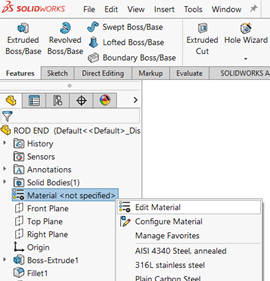
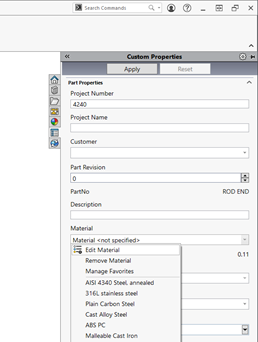
Right-click on the Material folder in the feature manager design tree (or the Custom Properties tab) and select Edit Material.
Next, right-click in the in the Material Library and select New Library.
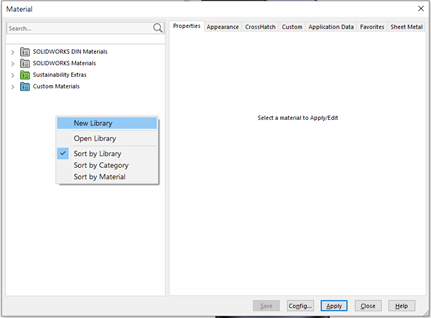
You can now choose what to name your new library and also which folder to save it to.
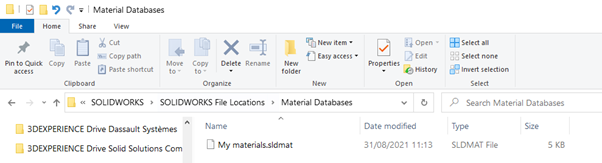
You will need to point SOLIDWORKS to this new location so it will know where to find it. The folder path is set in your SOLIDWORKS System Options > File Locations > Material Databases.
Tip; If you are part of a team of SOLIDWORKS users it is recommended to all share the same Material Library to ensure consistency. This is done by placing it in a shared file location that all users can access.
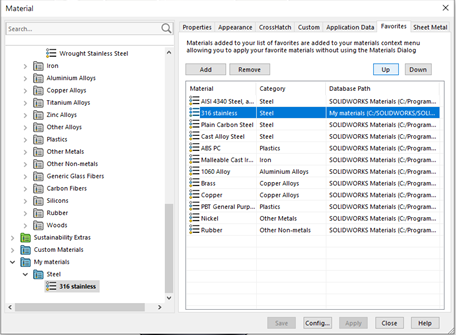
Materials can be organised into category folders such as Steel, Plastics and Timber. To create a Category simply right-click on your new library and select New Category.
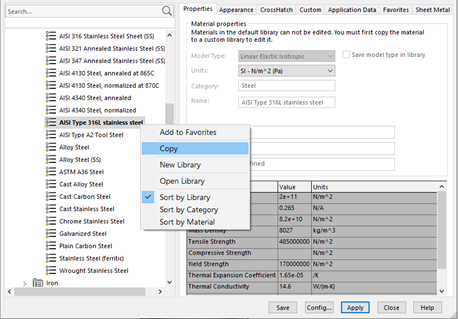
New materials can be defined from scratch by right-clicking on a Category folder and selecting New Material and entering the material data. An easier method is to find something similar and with a right-click select Copy, then paste it into a Category folder and edit its values to suit.
All materials in your custom library are fully editable so you can change the material name (to make it easily recognisable), its visual appearance and its mechanical properties. Remember to hit Save to keep any changes you make.
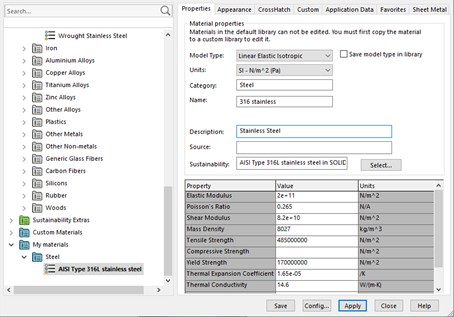
Material data can be obtained in a number of ways, including material data sheets from the supplier, or by visiting www.matweb.com and searching through the online database of material definitions.
If you use certain materials frequently it may be a good idea to customise your material favourites list. This can be done by clicking Manage Favorites, finding a material, then clicking on the Add button to add it to the list. This list can be reordered using the Up and Down buttons.
Categorised as: SOLIDWORKS Design
Get Expert SOLIDWORKS Training
Get hands-on SOLIDWORKS training in-person or online, led by certified experts with real industry experience. With venues across the UK & Ireland, it’s easy to start learning today.
Related Posts

How to Find Reaction Forces in SOLIDWORKS Simulation
SOLIDWORKS helps us to find resultant forces through simulation studies. These virtual tests reduce the need for physical prototypes and give us an accurate answer.

Setting number of decimal places in a table on a drawing
When creating an equation in a drawing general table, is it possible to define the…
SOLIDWORKS Smart Fasteners
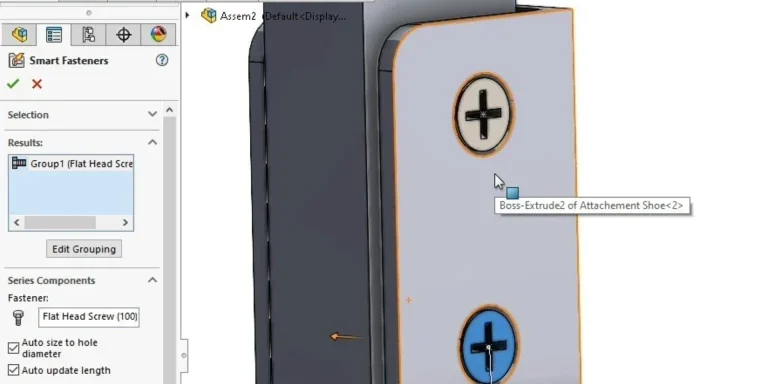
SOLIDWORKS Smart Fasteners is a really useful time saving tool, allowing you to automatically insert toolbox fasteners such as bolts and screws into an assembly providing there is a standard hole.
Why is my Flat Pattern not showing in SOLIDWORKS Drawings?
This may be linked to how the drawing is saved or it can be related to how sheet metal parts are displayed in drawings, read on to find out how to fix it.

SOLIDWORKS Tips: Are you Making this Common Mistake in Fatigue Analysis?
Simulation is a vital and complex engineering need. Fortunately, SOLIDWORKS makes it easy to test, correct mistakes and obtain accurate results.

How to Recover SOLIDWORKS Files After a Crash
SOLIDWORKS has two different methods to help you recover from an unexpected crash or loss of data in the form of auto-recovery and back-up settings.

Redesigning Santa’s Sleigh in SOLIDWORKS
Every year Father Christmas has to fly in his sleigh to deliver presents to boys and girls all over the world in just one night. To put this into perspective, it takes a little under 24 hours to fly from London (UK) to Sydney (Australia) in a streamlined Boeing 747, whereas Father Christmas’ mode of transport is believed to be a rather non-aerodynamic sleigh.

SOLIDWORKS Grid Systems – hidden away, but very useful!
Rory Niles provides an insight into the uses for Grid Systems within SOLIDWORKS 2018
Furniture Design Made Easy with SOLIDWORKS
Calling all furniture and interior designers: the days of creating square cabinets are over. What if we told you there’s a much easier way to bring your products to life?
Here’s 10 reasons why we feel SOLIDWORKS is better than any other software, especially if you’re designing furniture:
Making 3D Textures from Images on SOLIDWORKS
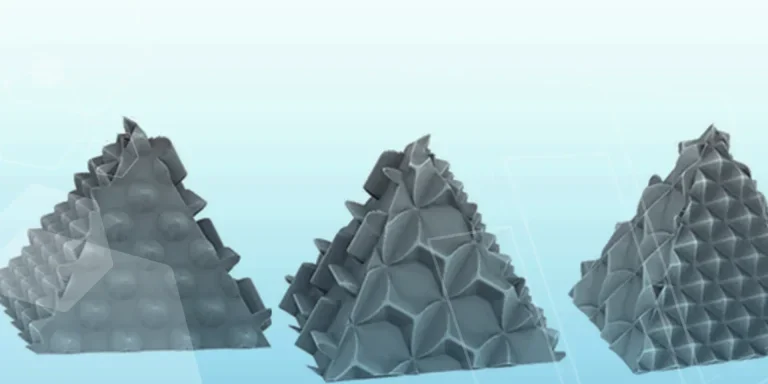
Turn images into 3D geometry with brand new SOLIDWORKS 3D Textures Feature