







Why 2D CAD Creates More Manual Work Than Expected

Written by: Sophie Dranfield
Published: Jun 3, 2026
| View All Blogs
2D CAD tools such as AutoCAD and DraftSight remain widely used across engineering and manufacturing. They provide a stable way to create technical drawings. As projects become more complex, teams often spend more time maintaining drawings rather than progressing design work. This change develops gradually and may not be obvious at first.
Where Manual Work Comes From
In a 2D environment, drawings are created view by view. Each view must be built, updated, and checked individually. When a design changes, that update does not flow automatically across all drawings. Engineers return to each view, make adjustments, and then check for consistency. Over time, these repeated actions increase the workload.
The Impact of Design Changes
A single design change can affect several drawings. Each one requires updates, which introduces additional checking and review steps. This increases the chance of inconsistencies and adds time to the process. The effect builds gradually as projects scale.
Coordination Across Teams
Drawings often pass between engineering, manufacturing, procurement, and external partners. Without a shared 3D reference, teams rely on interpretation. This can lead to questions, clarification requests, and additional revisions. The design work remains intact, but communication takes more effort.
Why This Often Goes Unnoticed
Many teams adapt to these workflows. Processes become familiar, and manual steps feel routine. The extra effort blends into daily work and is rarely measured directly. Patterns become clearer over longer periods or larger projects.
How 3D CAD Reduces Manual Effort
A 3D system centres around a single model. That model drives the design and the drawings. When a change is made, it updates across the related outputs. This removes the need to edit each view separately and keeps files consistent.
What This Means for Everyday Work
Engineers spend less time updating and checking drawings. There is less need to cross-reference between files, and changes move through the design more smoothly. The focus shifts toward developing the design rather than maintaining documentation.
Transition Considerations
A move from 2D to 3D does not require immediate replacement of all drawings. Many teams continue to use existing files while introducing 3D work gradually. New projects often provide the starting point. This approach allows progress without disruption.
Final Thoughts
2D CAD continues to support many workflows. As complexity increases, the amount of manual effort involved in maintaining drawings becomes more visible. A model-based approach reduces that effort and allows teams to focus more on design work.
Next Steps
If you are reviewing a move to 3D CAD, the following resources may help:
Frequently Asked Questions
Why does 2D CAD require more manual work?
In 2D CAD, drawings are created and updated separately. When a design changes, each view must be adjusted individually, which increases repetitive work.
Do all teams experience this issue with 2D CAD?
Not always. The impact becomes more noticeable as projects grow in size and complexity.
How does 3D CAD reduce manual work?
3D CAD uses a single model to drive drawings. Changes update across the design automatically, which reduces repeated edits.
Is 2D CAD still useful?
Yes. 2D CAD is still widely used for documentation. Many teams combine it with 3D workflows where appropriate.
Do teams need to replace all drawings to move to 3D?
No. Many teams keep existing drawings and introduce 3D gradually to avoid disruption.
Categorised as: Design | DraftSight | Industry Insight | Services
Get a SOLIDWORKS Quote
Interested in SOLIDWORKS? Contact us for questions, trials, or demos by clicking the button below or call 01926 333777. Our experts will help you find the perfect solution.

Related Posts

How to Find Reaction Forces in SOLIDWORKS Simulation
SOLIDWORKS helps us to find resultant forces through simulation studies. These virtual tests reduce the need for physical prototypes and give us an accurate answer.

Setting number of decimal places in a table on a drawing
When creating an equation in a drawing general table, is it possible to define the…
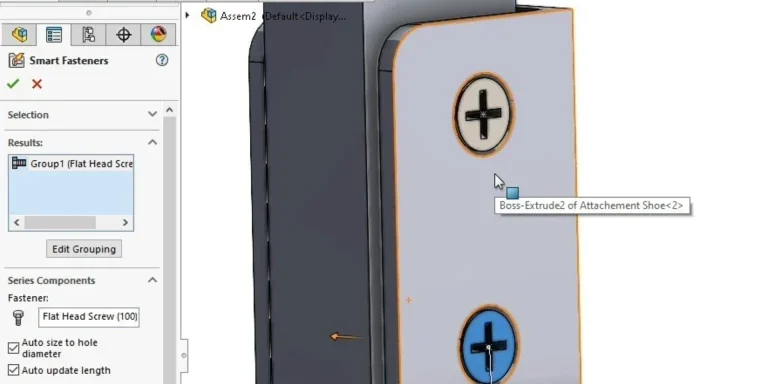
SOLIDWORKS Smart Fasteners
SOLIDWORKS Smart Fasteners is a really useful time saving tool, allowing you to automatically insert toolbox fasteners such as bolts and screws into an assembly providing there is a standard hole.
Why is my Flat Pattern not showing in SOLIDWORKS Drawings?
This may be linked to how the drawing is saved or it can be related to how sheet metal parts are displayed in drawings, read on to find out how to fix it.

SOLIDWORKS Tips: Are you Making this Common Mistake in Fatigue Analysis?
Simulation is a vital and complex engineering need. Fortunately, SOLIDWORKS makes it easy to test, correct mistakes and obtain accurate results.
Series 1 Land Rover Pedal Car – Made Easy with Solidworks!
The Series1 began production in 1948 designed to help get Britain farming after the war effort. It grew extremely popular and today enthusiasts are prepared to throw their life savings at restoring originals from that period.

How to Recover SOLIDWORKS Files After a Crash
SOLIDWORKS has two different methods to help you recover from an unexpected crash or loss of data in the form of auto-recovery and back-up settings.

Redesigning Santa’s Sleigh in SOLIDWORKS
Every year Father Christmas has to fly in his sleigh to deliver presents to boys and girls all over the world in just one night. To put this into perspective, it takes a little under 24 hours to fly from London (UK) to Sydney (Australia) in a streamlined Boeing 747, whereas Father Christmas’ mode of transport is believed to be a rather non-aerodynamic sleigh.
SOLIDWORKS Grid Systems – hidden away, but very useful!
Rory Niles provides an insight into the uses for Grid Systems within SOLIDWORKS 2018
Furniture Design Made Easy with SOLIDWORKS
Calling all furniture and interior designers: the days of creating square cabinets are over. What if we told you there’s a much easier way to bring your products to life?
Here’s 10 reasons why we feel SOLIDWORKS is better than any other software, especially if you’re designing furniture: