








CAD to Circuit: Silverstone
Written by: Sophie Dranfield
Published: Aug 3, 2026
| View All Blogs
Part 3 | Keeping Cool at Silverstone
Silverstone has a way of exposing weaknesses.
The circuit carries a unique place in motorsport. It hosted the first Formula One World Championship race in 1950 and remains one of the defining venues in world motorsport. Even today, the 3.6-mile Grand Prix circuit rewards confidence through some of the most recognisable sequences of corners in racing.
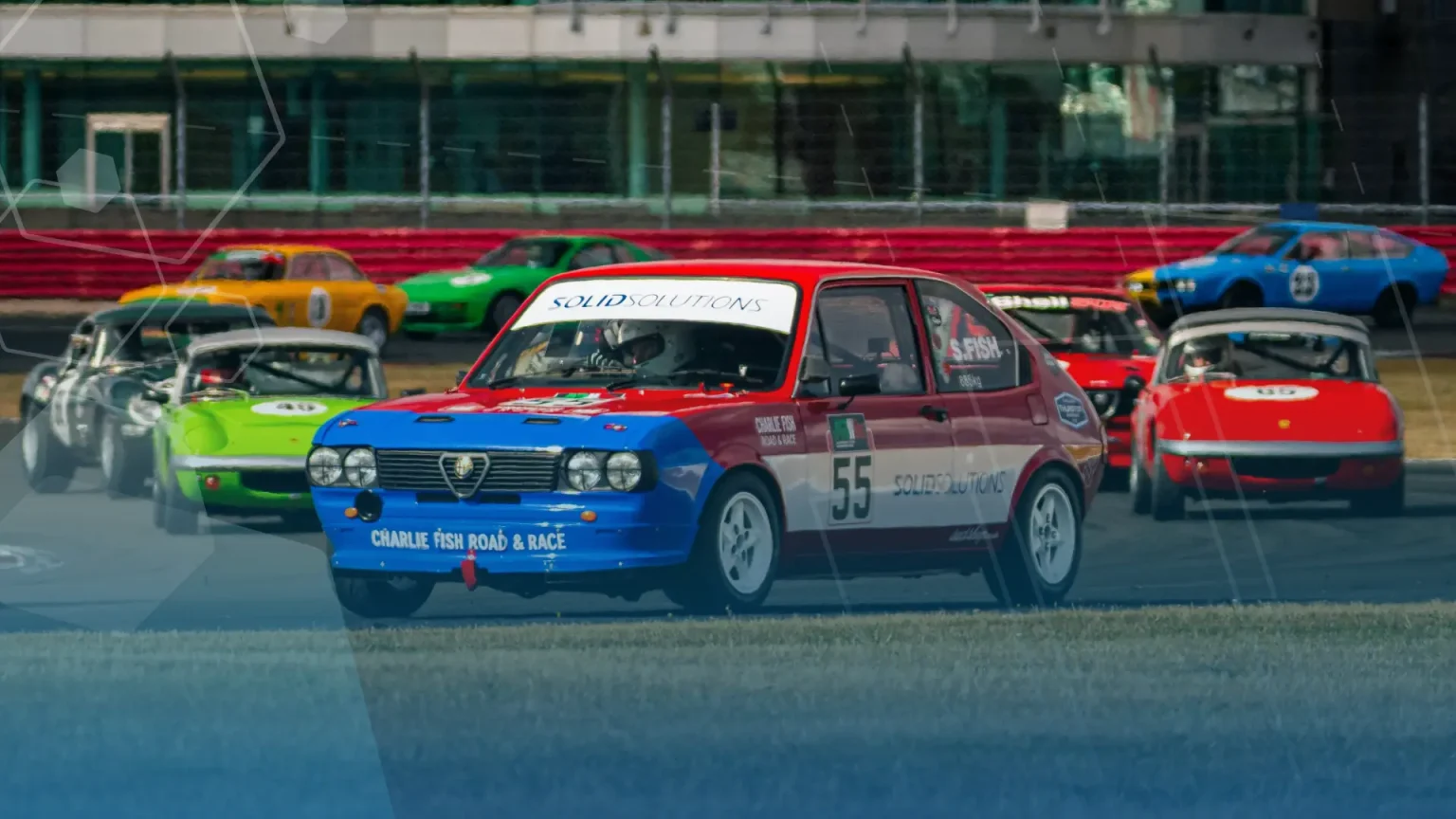
For Sam Fish and the Fish Fabrications Alfasud, Silverstone presented a very different challenge to the events that came before it.
Snetterton proved the car.
Oulton Park improved it.
Silverstone tested the driver.
More Than Another Race Weekend

The event itself carried added significance.
The BRDC Classic brings together machinery spanning almost a century of motorsport history, creating one of the most diverse historic racing gatherings in the UK calendar. Across the weekend, more than 300 competitors took to the circuit in machinery ranging from pre-war sports cars to touring cars, GT cars and historic Formula One machinery.
For Sam Fish and the Alfasud, it meant racing on one of the sport’s most famous stages, surrounded by some of the most iconic cars in motorsport history.
That scale brings its own challenges. It also provides one of the most demanding environments in the country for testing new ideas, validating developments and understanding how a car performs over race distance.
Heat Inside the Cockpit

Anyone watching from the outside sees speed, noise and close racing. What they do not see is the environment inside the car.
During summer race weekends, drivers spend extended periods strapped into confined cockpits wearing race suits, helmets and safety equipment while waiting in assembly areas, on the grid and during races.
At Silverstone, temperatures climbed towards 28°C and the next development target quickly became obvious.
Keeping the driver cool.
Sam knew exactly where the problem sat.
“I really struggle with the heat in the car, so I developed an external duct that fits onto the door and captures air at the edge of the windscreen where it is travelling fastest.”
The objective was creating a solution that could be integrated into the car without affecting visibility, altering the character of the Alfasud, or introducing unnecessary complexity.
Like any worthwhile engineering project, it started with understanding the problem before creating the solution.
Capturing Airflow

Rather than creating another opening in the bodywork, Sam focused on an area where airflow was already working in his favour.
The edge of the windscreen presented an opportunity. Using SOLIDWORKS, a new external intake was developed to capture airflow at one of the fastest-moving points around the car and direct it into the cockpit.
“This directs the air into ducting that aims straight onto me. It works incredibly well and made such a difference during the 28-degree heat. Fresh air straight onto the driver.”
The component was produced using a Bambu Lab H2S 3D printer supplied through Solid Print.
The flexibility of additive manufacturing allowed new versions to be produced, fitted and assessed quickly before race weekend. One early prototype solved the airflow problem but introduced another.
“I was able to try multiple versions until I found one that worked best, including removing a whistling sound that occurred on an early prototype.”
The design evolved rapidly. New iterations could be printed overnight, fitted to the car and assessed in real-world conditions.
The final version blended neatly into the side window using translucent PETG while continuing to deliver the airflow required inside the cockpit.
From Model to Motorsport

The finished component looks simple.
Reaching that solution wasn’t.
The driver cooling duct began as an idea in SOLIDWORKS, evolved through multiple iterations and arrived at Silverstone as a fully functional component ready to be evaluated under race conditions.
That process sits at the heart of motorsport engineering.
Every version taught something. One improved airflow. Another improved fitment. One solved the cooling problem but introduced an unexpected whistle. By the time the car arrived at Silverstone, the final design had been shaped by dozens of small decisions.
Development is rarely a straight line. The objective is not perfection on the first attempt. The objective is to keep moving forward.
A Power Circuit. A Little Alfa-Sud.

While development continued in the paddock, the racing itself provided another surprise.
Silverstone’s Grand Prix circuit stretches to 3.6 miles and has built its reputation around fast, flowing sections where power often makes the difference.
The Alfasud arrived with 155bhp, and expectations were realistic.
The stopwatch had other ideas.
Testing provided limited opportunity to learn one of the world’s most famous circuits, but the early pace looked encouraging.
Sam was just as surprised as anyone.
“I thought there must be a mistake in the data.”
As it turned out, there wasn’t.
“This 3.6-mile track is known to be a power circuit that suits fast cars, not little Alfasuds with 155bhp.”
Finding Pace Among 48 Cars

Traffic became a challenge long before outright pace.
With 48 cars sharing the Silverstone Grand Prix circuit during qualifying, finding clear track was often as important as finding speed.
Even so, Sam secured 11th place on the grid.
“My 2:37.5 lap time put me 11th out of 48. A great result and ahead of some much faster cars.”
For a car that many would have overlooked on paper, it was an exceptional result.
Racing at Silverstone

The opening race delivered exactly the kind of competition that makes historic motorsport so compelling.
Starting amongst significantly more powerful machinery, Sam immediately found himself fighting for position.
“I jumped past the Ferrari, for a corner anyway, and then had a mammoth battle with the Alfasud Sprint and TVR for three or four laps.”
The Alfasud crossed the line in tenth overall and second in class.
The second race brought a fresh challenge. An incident further up the road scattered stones across the circuit and damaged the windscreen, but the Alfasud avoided trouble and remained in contention.
Sam finished eleventh overall and first in class.
“I was determined to look forward and not be swallowed up by the faster cars around.”
By the chequered flag, Silverstone had delivered one of the strongest weekends of the season.
Engineering Conversations in the Paddock

Beyond the racing itself, Silverstone also demonstrated the value of bringing engineering stories into the paddock.
Throughout the weekend, visitors stopped to ask about the Alfasud, its development programme and the role SOLIDWORKS played in taking ideas from screen to circuit.
As Sam noted afterwards:
“We had quite a few people come and chat about SOLIDWORKS at this event, which is nice.”
Those conversations reflected exactly what this partnership was designed to showcase.
Not engineering in theory.
Engineering under pressure.
Developed, refined and proven in the real world.
Development Never Stops

One of the most valuable lessons in motorsport is that every success reveals the next opportunity.
The brake cooling system evolved again before Silverstone, incorporating revised internal geometry and improved airflow management, while the driver cooling duct made its first appearance under race conditions.
Both developments began with a problem that needed solving. They evolved through design, iteration and testing before being evaluated where it matters most: on track.
The next chapter has already begun.
“Attention turns to developments for racing next year.”
Race weekends provide the milestones.
Progress is measured in iterations.
Engineering does not stop when the race begins.
That is when the testing starts.
Continue the Journey
CAD to Circuit Series
Part 1 | Engineering Tested at Speed
Snetterton Circuit and the first competitive outing for the Alfasud.
Part 2 | Engineering Under Pressure
How SOLIDWORKS and 3D printing solved a brake cooling challenge at Oulton Park.
Part 3 | Keeping Cool at Silverstone
Developing and validating a new driver cooling solution at Silverstone.
(Current article)
Watch the Races
Further onboard footage and race content can be found on the Fish Fabrications YouTube channel.
Follow Fish Fabrications
Technology Used
Categorised as: Customer Stories | Design | Industry Insight | Manufacturing
What's New in SOLIDWORKS?
Explore the latest innovations in SOLIDWORKS with our exclusive breakdown of live webinar, giving you on-demand access to the insights that matter most to your workflow.
Related Posts
How to Find Reaction Forces in SOLIDWORKS Simulation
SOLIDWORKS helps us to find resultant forces through simulation studies. These virtual tests reduce the need for physical prototypes and give us an accurate answer.

Setting number of decimal places in a table on a drawing
When creating an equation in a drawing general table, is it possible to define the…
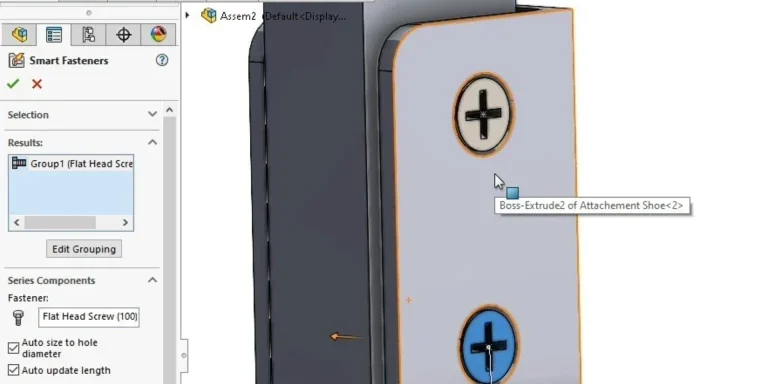
SOLIDWORKS Smart Fasteners
SOLIDWORKS Smart Fasteners is a really useful time saving tool, allowing you to automatically insert toolbox fasteners such as bolts and screws into an assembly providing there is a standard hole.
Why is my Flat Pattern not showing in SOLIDWORKS Drawings?
This may be linked to how the drawing is saved or it can be related to how sheet metal parts are displayed in drawings, read on to find out how to fix it.

SOLIDWORKS Tips: Are you Making this Common Mistake in Fatigue Analysis?
Simulation is a vital and complex engineering need. Fortunately, SOLIDWORKS makes it easy to test, correct mistakes and obtain accurate results.
Series 1 Land Rover Pedal Car – Made Easy with Solidworks!
The Series1 began production in 1948 designed to help get Britain farming after the war effort. It grew extremely popular and today enthusiasts are prepared to throw their life savings at restoring originals from that period.
How to Recover SOLIDWORKS Files After a Crash
SOLIDWORKS has two different methods to help you recover from an unexpected crash or loss of data in the form of auto-recovery and back-up settings.
Redesigning Santa’s Sleigh in SOLIDWORKS
Every year Father Christmas has to fly in his sleigh to deliver presents to boys and girls all over the world in just one night. To put this into perspective, it takes a little under 24 hours to fly from London (UK) to Sydney (Australia) in a streamlined Boeing 747, whereas Father Christmas’ mode of transport is believed to be a rather non-aerodynamic sleigh.
SOLIDWORKS Grid Systems – hidden away, but very useful!
Rory Niles provides an insight into the uses for Grid Systems within SOLIDWORKS 2018
Furniture Design Made Easy with SOLIDWORKS
Calling all furniture and interior designers: the days of creating square cabinets are over. What if we told you there’s a much easier way to bring your products to life?
Here’s 10 reasons why we feel SOLIDWORKS is better than any other software, especially if you’re designing furniture: