











A Simple Approach to Modelling Fluid-Filled Structures with MSC Marc

Written by: Tom McHale
Published: Jan 26, 2024
| View All Blogs
Simulating the static loading of closed containers can lead to issues of approximating the effects on the structural behaviour by the fluid contained within.
With air, we’ve commonly seen it ignored with an assumption that the internal volume doesn’t change ‘much’ so the pressure doesn’t either.
But what if you have a liquid-filled container? Do you need to move to couple physics to model the internal fluid with a CFD solution?
It depends on what you’re doing, but if you’re not interested in the movement of the fluid and just the stiffness effect it has on the structure, then MSC Marc can help.
As an example, here are two axisymmetric simulations of a ball being compressed between two plates.

Fluid-less Void Compression</div>

Fluid-filled Compression
The first one shows the behaviour assuming there’s no internal fluid of any kind, and the second shows the change when we fill the ball with a liquid and constrain the total mass as fixed.
The Cavity feature has been in Marc for many years, introduced just for gases originally, around a demand from the tyre industry.
It allowed you to define a closed volume and the properties of the ideal gas within it – this could be a 3D volume, but it also worked for 2D solids like axisymmetric conditions.
The cavity could be constrained to have a fixed mass, the mass could change over time (to simulate a leak for example), or the cavity pressure could be controlled to simulate inflation/deflation. This was simply done using Boyle’s Law with Marc calculating the volume enclosed by the cavity at each load increment.
The ability to support liquids was introduced in 2014 which enhanced the functionality greatly.
Setting this up in the GUI, Mentat, is very simple. For a 3D entity you need to have a volume enclosed by the elements selected as the cavity.
In the example below the ‘sausage’ of thin rubber shell elements is selected. All the element normals need to be aligned to point inside or outside of course.
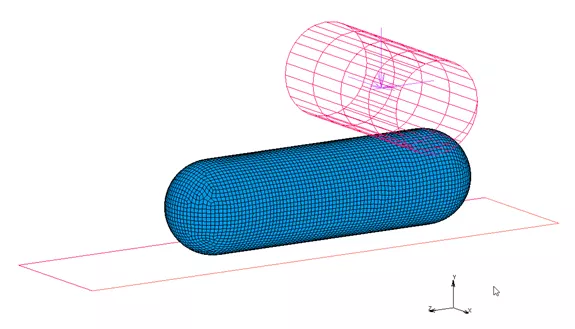
In this case we are going to squeeze the tube between the rigid roller and the ground plate, then move the roller axis along the major axis of the tube to see how the fluid internally affects the behaviour.
We do this with one simple load – a Cavity Mass Load – where we tell Marc that the mass of the cavity is fixed, and then run the simulation.
The plot below is showing contact status, a result to indicate where contact is taking place.

We get results output for the cavity as a whole rather than local face pressure results – this is not a transient looking at the flow of fluid but a static assuming the cavity pressure is uniform.
The example below shows an axisymmetric seal model with three cavities, two air-filled and one liquid-filled.

We can see the collapse of the two air-filled ones and the corresponding pressure rises, while the liquid filled (rightmost) appears to retain its volume.
The graph of Volume vs Time shows the true story: the liquid filled cavities are treated as ‘almost incompressible’.
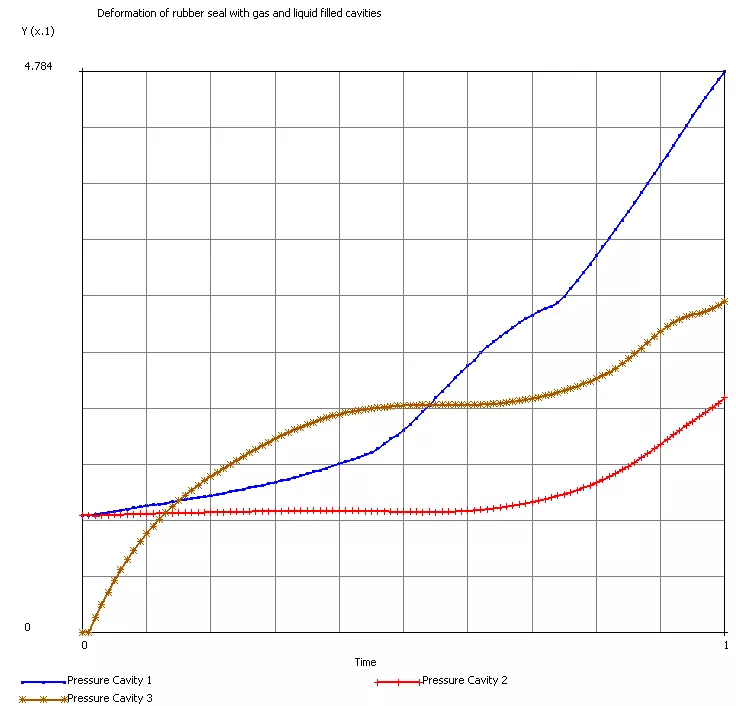 Pressure vs Time
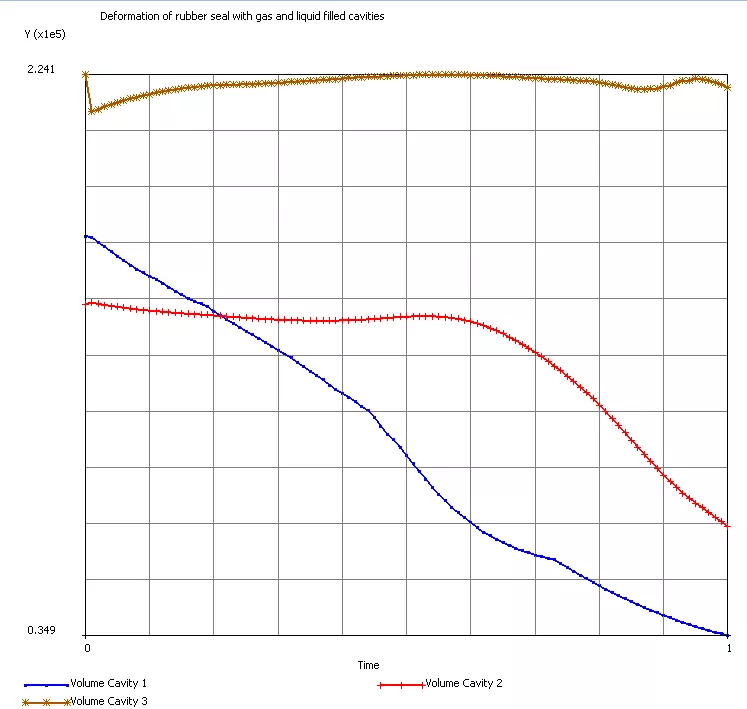 Volume vs Time
This technique is fantastic for modelling fluid-filled containers under static loading.
The mass of the fluid is not included in the mass matrix for a dynamic solution, nor can you apply gravity or centrifugal loading to the fluid mass, nor can you model partially full containers, but it is useful nonetheless for many applications.
If you think this might help you with your product performance assessment and simulation, then please get in touch for a chat about your requirements. Fill in the form below to get started.
MSC Marc is available within the MSC.One token licensing system which comes in a Start Edition flavour that is very affordable for smaller customers.
Categorised as: Simulation
Get Expert SOLIDWORKS Training
Get hands-on SOLIDWORKS training in-person or online, led by certified experts with real industry experience. With venues across the UK & Ireland, it’s easy to start learning today.
Related Posts

How to Find Reaction Forces in SOLIDWORKS Simulation
SOLIDWORKS helps us to find resultant forces through simulation studies. These virtual tests reduce the need for physical prototypes and give us an accurate answer.

SOLIDWORKS Tips: Are you Making this Common Mistake in Fatigue Analysis?
Simulation is a vital and complex engineering need. Fortunately, SOLIDWORKS makes it easy to test, correct mistakes and obtain accurate results.

Redesigning Santa’s Sleigh in SOLIDWORKS
Every year Father Christmas has to fly in his sleigh to deliver presents to boys and girls all over the world in just one night. To put this into perspective, it takes a little under 24 hours to fly from London (UK) to Sydney (Australia) in a streamlined Boeing 747, whereas Father Christmas’ mode of transport is believed to be a rather non-aerodynamic sleigh.

Radiation in Flow Simulation – Part 1 : Reflection
Technical Manager Andy Fulcher explores ‘Radiation in Flow Simulation, Part 1 : Reflection’

Radiation in Flow Simulation – Part 2 : Refraction
Technical Manager Andy Fulcher explores ‘Radiation in Flow Simulation, Part 2 : Refraction’
The Coanda Effect in Flow Simulation
Can you take advantage of the Coanda Effect & can SOLIDWORKS Flow simulate it? Applications Engineer Romel Cumare investigates in his latest blog post.
So how accurate is SOLIDWORKS Simulation?
How accurate is SOLIDWORKS Simulation? Elite Applications Engineer Chris Boyles investigates.

Set Your Fluids Free with SOLIDWORKS Flow Simulation
A look at the new Free Surface feature coming in SOLIDWORKS Flow Simulation 2018.
Finding a Good Mesh Fast in SOLIDWORKS Flow Simulation
‘How do I know when to stop my calculation?’ and ‘How do I know my mesh is good enough?’ are questions often asked when running SOLIDWORKS Flow Simulation studies.
The answer is to ensure the solution reached is both fully converged AND mesh independent. In practice this can take a bit of trial and error as well as some experience in the process. However, SOLIDWORKS Flow can help us do both of these at once! Here’s how…

Free Surface Evaluation & Validation – SOLIDWORKS Flow Simulation
In 2018 SOLIDWORKS introduced a new capability to their Flow software. This is called ‘Free Surface’ and opens up many more applications for users who need to simulate fluid behaviour where a gas and a liquid (or two immiscible liquids) share the same region of space without an intervening solid