








3DEXPERIENCE vs Windows 11: How Managing SOLIDWORKS Data in the Platform Compares to File Explorer
Written by: Wayne Marshall
Published: May 13, 2025
| View All Blogs
Understanding the 3DEXPERIENCE platform can seem like a daunting task.
The platform brings together a host of powerful software tools known as ‘roles’, that provide the functionality design teams require to conceptualise products and take them to market.
This article explains how the 3DEXPERIENCE platform stores and references SOLIDWORKS CAD files, and demonstrates how the platform’s model provides greater control than traditional Windows file management techniques.
Windows vs 3DEXPERIENCE: A Side-by-Side Comparison
When it comes to storing files and design data, we can draw parallels between the platform and the Windows operating system.
Ultimately, they are not direct competitors, but by aligning new concepts with familiar terms, we can begin to understand where the 3DEXPERIENCE platform fits within a team’s technology stack.
| Concept | Windows | 3DEXPERIENCE |
|---|---|---|
| Platform | Windows OS | 3DEXPERIENCE (ENOVIA-based) |
| Create & Edit | SOLIDWORKS desktop | SOLIDWORKS on 3DEXPERIENCE |
| Access & Organise | File Explorer folders | 3DSpace (spaces & sub-spaces) + Bookmarks |
| Identifiers | File Name | Title, Component Name, Name (background ID) |
The Windows operating system (OS) has been providing PC users with the opportunity to access software tools since 1985.
Consider how the Windows OS opens up the route to access these tools and applications (like SOLIDWORKS and Microsoft Office), and how it provides users with the infrastructure to support their professional and personal endeavours, no matter their task.

The 3DEXPERIENCE platform brings together all of the major Dassault Systèmes software brands.
In the same way, the 3DEXPERIENCE platform supports engineers, product developers, and designers with access to additional functionality and toolsets that extend far beyond SOLIDWORKS 3D CAD and into advanced data management, manufacturing, and complex simulation tools.
What can the 3DEXPERIENCE Platform do?
As you explore the 3DEXPERIENCE platform, you’ll encounter ‘roles’. These are bundles of software applications that provide functionality including 3D CAD and subdivision modelling tools, product data and lifecycle management, CAM and shop floor manufacturing tools and so much more.
The 3DEXPERIENCE platform consists of a variety of roles that each provide different functionality and are separately licensed.
Each role unlocks access to a unique set of software applications from one of Dassault Systèmes’ major software brands (including CATIA, ENOVIA, SIMULIA, and DELMIA among others) that provide tools to assist designers, marketers, managers, and more!
In this article, we’re focusing on the data management tools powered by ENOVIA to connect SOLIDWORKS and CATIA V5 with the 3DEXPERIENCE platform.
These tools are included with the Cloud Services to enable secure file storage, tracking, and management on the 3DEXPERIENCE platform rather than the standard Windows File Explorer, OneDrive, or Dropbox.
Key Benefits of 3DEXPERIENCE Platform Storage
You may already be familiar with some of the reasons why you should manage your CAD data on the 3DEXPERIENCE platform, but it’s worth reiterating some of the major benefits.
SOLIDWORKS users storing CAD data on the 3DEXPERIENCE platform can benefit from:
- Granular Access Control: Grant or revoke access at the space level.
- Flexible Organisation: Add/remove bookmarks without moving underlying data.
- Visual Reference Tracking: Bookmarked assemblies show child references in a dropdown.
- Single Source of Truth: All users see the same published data hierarchy.
SOLIDWORKS files can be easily accessed online from any connected device, and the integrated add-in allows for file maturity and other properties to be managed inside of SOLIDWORKS.
To effectively manage this data, it’s important to be aware of the file hierarchies that Windows and the 3DEXPERIENCE platform structure apply to stored data.
The 3DEXPERIENCE File Hierarchy
It’s important to understand what your data looks like when accessed from any data management system.
The table below shows how Windows and the 3DEXPERIENCE platform will consider the equivalent folder/file structure in the context of SOLIDWORKS CAD files.
| Windows | 3DEXPERIENCE |
|---|---|
| Folder → File (SLDPRT/SLDASM) | 3DSpace → Physical Product / CAD Family → Representation |
| Single-config part or assembly | One Physical Product |
| Multi-configurations | One CAD Family + one Physical Product per config |
| Derived configurations | Representations (only visible inside SOLIDWORKS session) |
NOTE: Representations are lightweight and don’t clutter your main list of products.
You’ll notice that the SOLIDWORKS configurations the Windows OS recognises are named differently in the 3DEXPERIENCE platform.
There, SOLIDWORKS configurations will be interpreted as ‘Physical Products’, and there are some important compatibility requirements you need to check before uploading SOLIDWORKS files to the 3DEXPERIENCE platform.
A Short Glossary of 3DEXPERIENCE Properties
After configurations, perhaps the most significant difference is how SOLIDWORKS will display and handle titles and file names in the platform.

TOP TIP: In the SOLIDWORKS add-in you can hide columns like Name, File Name or Component Name to reduce on-screen clutter.
Title vs File Name vs Component Name
Let’s quickly clarify a few of the key terms that you’ll need to know:
- File Name: This is the Windows file name (e.g. Bracket.SLDPRT).
- Title: The user-friendly name you assign in 3DEXPERIENCE. Replaces File Name in many SOLIDWORKS displays.
- Component Name: Matches Title if set; otherwise defaults to File Name.
- Name (3DEX property): Internal background identifier not typically needed by end users.
While the names may have changed, their function remains the same!
Aligning Your SOLIDWORKS UI
To help SOLIDWORKS users become familiar with working in the 3DEXPERIENCE platform, we suggest administrators can assist users by modifying the SOLIDWORKS interface to mirror the workflows of the 3DEXPERIENCE platform.
- In the 3DEXPERIENCE add-in Options, choose to display Title instead of File Name.
- Disable unwanted columns (e.g. Name) to focus on Titles and Structures.
- Save your custom layout to streamline daily workflows.
Just like Windows and other OS, the 3DEXPERIENCE platform has its own language for us to learn.
Once familiar, we can manage product and CAD data efficiently, communicate effectively, and wield powerful tools as we design and manufacture innovations that will also change the world.
Take the Next Steps
Get the most out of your 3DEXPERIENCE platform with our step-by-step starter guides and guided implementation services.
Together with our TriMech Group partners, these 3DEXPERIENCE platform starter guides can help to onboard new administrators and users of your 3DEXPERIENCE platform.
Categorised as: 3DEXPERIENCE | Data Management | SOLIDWORKS Design
Get a SOLIDWORKS Quote
Interested in SOLIDWORKS? Contact us for questions, trials, or demos by clicking the button below or call 01926 333777. Our experts will help you find the perfect solution.

Related Posts

How to Find Reaction Forces in SOLIDWORKS Simulation
SOLIDWORKS helps us to find resultant forces through simulation studies. These virtual tests reduce the need for physical prototypes and give us an accurate answer.

Setting number of decimal places in a table on a drawing
When creating an equation in a drawing general table, is it possible to define the…
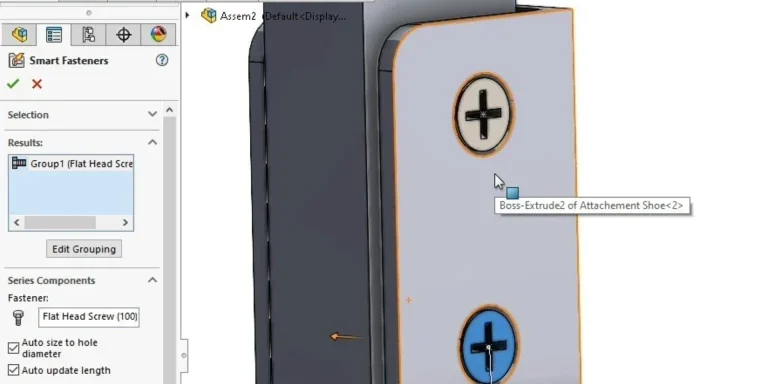
SOLIDWORKS Smart Fasteners
SOLIDWORKS Smart Fasteners is a really useful time saving tool, allowing you to automatically insert toolbox fasteners such as bolts and screws into an assembly providing there is a standard hole.
Why is my Flat Pattern not showing in SOLIDWORKS Drawings?
This may be linked to how the drawing is saved or it can be related to how sheet metal parts are displayed in drawings, read on to find out how to fix it.

SOLIDWORKS Tips: Are you Making this Common Mistake in Fatigue Analysis?
Simulation is a vital and complex engineering need. Fortunately, SOLIDWORKS makes it easy to test, correct mistakes and obtain accurate results.

How to Recover SOLIDWORKS Files After a Crash
SOLIDWORKS has two different methods to help you recover from an unexpected crash or loss of data in the form of auto-recovery and back-up settings.

Redesigning Santa’s Sleigh in SOLIDWORKS
Every year Father Christmas has to fly in his sleigh to deliver presents to boys and girls all over the world in just one night. To put this into perspective, it takes a little under 24 hours to fly from London (UK) to Sydney (Australia) in a streamlined Boeing 747, whereas Father Christmas’ mode of transport is believed to be a rather non-aerodynamic sleigh.
SOLIDWORKS Grid Systems – hidden away, but very useful!
Rory Niles provides an insight into the uses for Grid Systems within SOLIDWORKS 2018
Furniture Design Made Easy with SOLIDWORKS
Calling all furniture and interior designers: the days of creating square cabinets are over. What if we told you there’s a much easier way to bring your products to life?
Here’s 10 reasons why we feel SOLIDWORKS is better than any other software, especially if you’re designing furniture:
Making 3D Textures from Images on SOLIDWORKS
Turn images into 3D geometry with brand new SOLIDWORKS 3D Textures Feature